Sample diagnosis, with fictional data.
This is what you receive after 2 to 3 weeks. The business is made up: a property management firm of 12 people that runs 38 buildings. Every number says whether it is a fact, an assumption or missing.
Example with fictional data. Not a client.
Property management firm, 12 people, 38 buildings
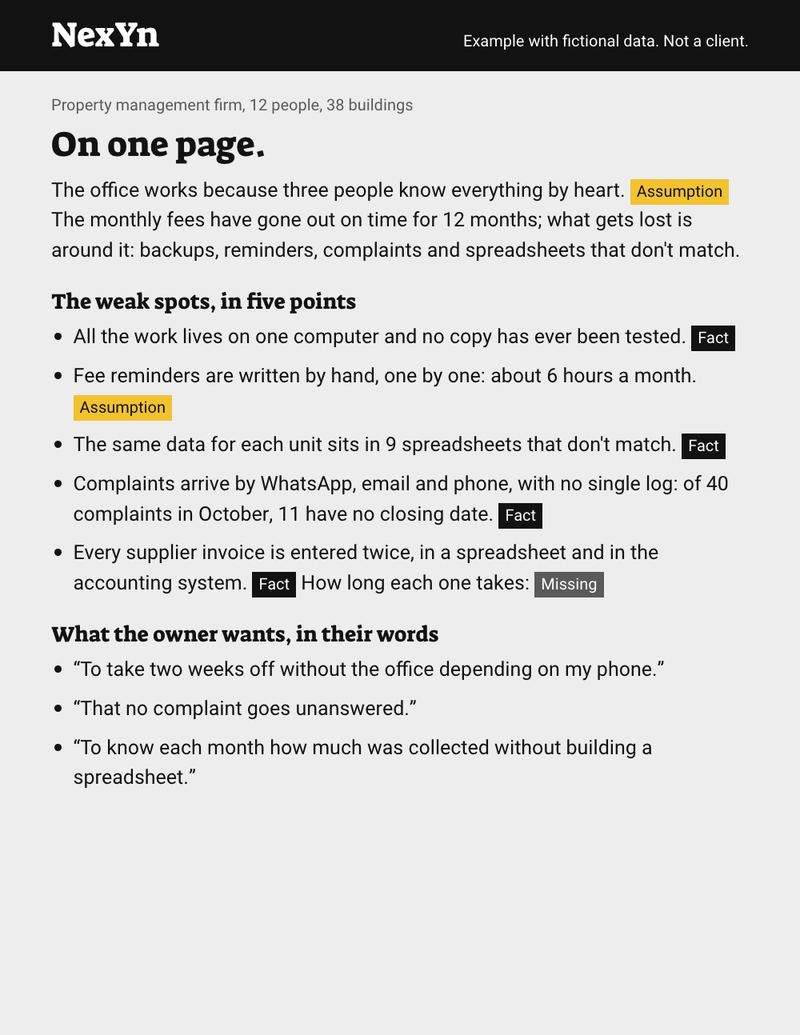
On one page.
The office works because three people know everything by heart. Assumption The monthly fees have gone out on time for 12 months; what gets lost is around it: backups, reminders, complaints and spreadsheets that don't match.
The weak spots, in five points
- All the work lives on one computer and no copy has ever been tested. Fact
- Fee reminders are written by hand, one by one: about 6 hours a month. Assumption
- The same data for each unit sits in 9 spreadsheets that don't match. Fact
- Complaints arrive by WhatsApp, email and phone, with no single log: of 40 complaints in October, 11 have no closing date. Fact
- Every supplier invoice is entered twice, in a spreadsheet and in the accounting system. Fact How long each one takes: Missing
What the owner wants, in their words
- “To take two weeks off without the office depending on my phone.”
- “That no complaint goes unanswered.”
- “To know each month how much was collected without building a spreadsheet.”
Property management firm, 12 people, 38 buildings
What works, and what to do this week.
What works is left alone. This week's list is done by hand, without AI, and takes a morning, plus a week of notes for D2. Assumption
What works: keep it
- The monthly fees have gone out on time for the last 12 months. Fact
- Owners' emails get an answer within two working days. Fact
- The accounting system is up to date and each person has their own login. Fact
This week, by hand
- Copy the work folder to an external drive and open three files from the copy.
- Change the shared password of the office email and turn on two-step verification.
- Choose which of the 9 spreadsheets is the master and write it in the first row of the other eight.
- Put the 11 open complaints in one folder and give each one to a person.
- For one week, note how long each fee reminder takes, to confirm the assumption behind D2.
Property management firm, 12 people, 38 buildings
Area by area.
What is there today, what can be automated, and what stays with a person.
Monthly fees
Today. Accounting system and a control spreadsheet. It goes out on time.
What to automate. Nothing for now. A check against the previous month goes in the next round of decisions.
What stays with a person. Review what is flagged and sign off the monthly fees.
Collections
Today. Reminders written by hand and a spreadsheet of late payers. How many reminders bounce: Missing
What to automate. Draft reminders (D2) and a weekly list of late payers, oldest first.
What stays with a person. Send the reminders and talk to each late payer.
Complaints
Today. Three channels and no log: 11 of 40 October complaints with no closing date. Fact
What to automate. One log that AI fills in from forwarded emails and messages, with the date received and who owns it (D4).
What stays with a person. Answer the owner and decide when a complaint is closed.
Suppliers
Today. Every invoice is entered twice. Fact
What to automate. AI reads the PDF invoice and prepares a single entry, which a person confirms (D5).
What stays with a person. Approve and make the payment.
Data
Today. 9 unit spreadsheets (D3), no tested copy (D1) and 3 folders with owners' data open to anyone with the link (D6). Fact
What to automate. One spreadsheet with one code per unit, a daily copy and an alert if a folder is left open.
What stays with a person. Decide who sees what.
Property management firm, 12 people, 38 buildings
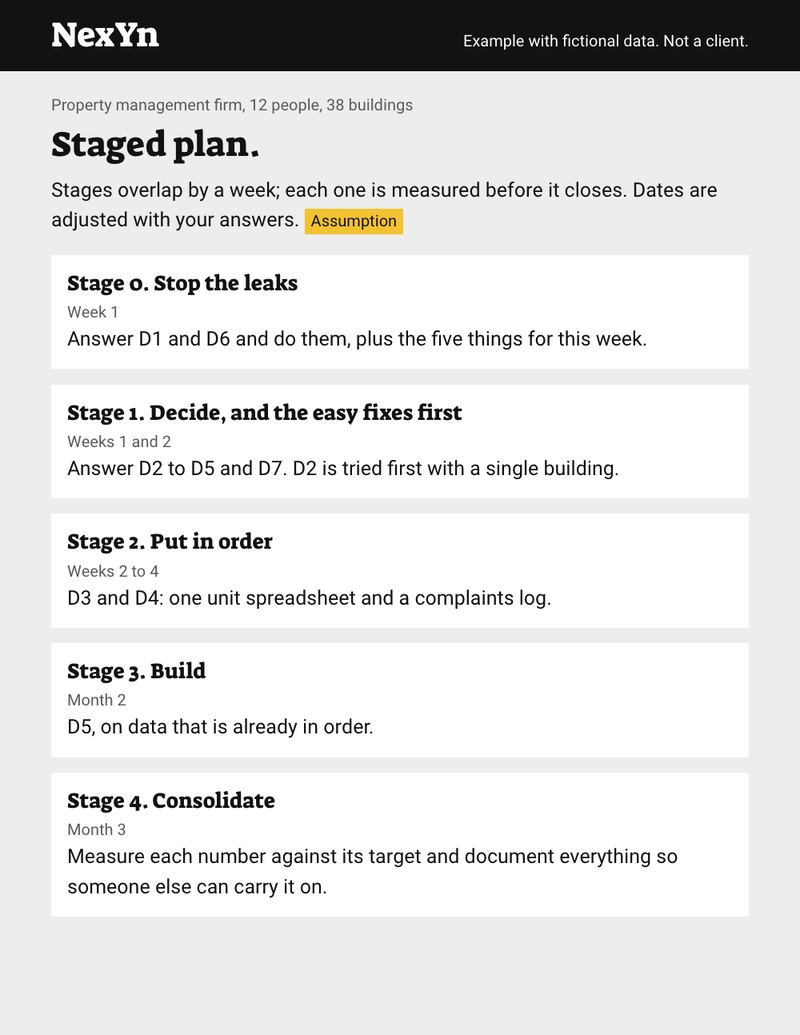
Staged plan.
Stages overlap by a week; each one is measured before it closes. Dates are adjusted with your answers. Assumption
Stage 0. Stop the leaks
Week 1
Answer D1 and D6 and do them, plus the five things for this week.
Stage 1. Decide, and the easy fixes first
Weeks 1 and 2
Answer D2 to D5 and D7. D2 is tried first with a single building.
Stage 2. Put in order
Weeks 2 to 4
D3 and D4: one unit spreadsheet and a complaints log.
Stage 3. Build
Month 2
D5, on data that is already in order.
Stage 4. Consolidate
Month 3
Measure each number against its target and document everything so someone else can carry it on.
Property management firm, 12 people, 38 buildings
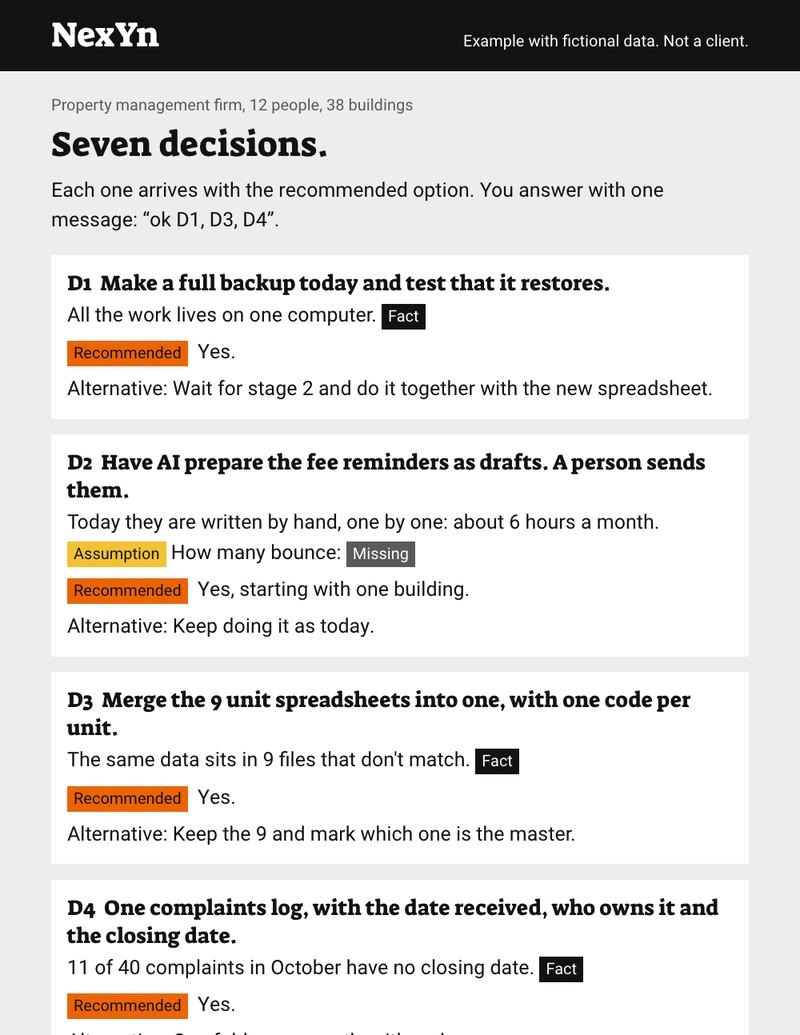
Seven decisions.
Each one arrives with the recommended option. You answer with one message: “ok D1, D3, D4”.
-
D1 Make a full backup today and test that it restores.
All the work lives on one computer. Fact
Recommended Yes.
Alternative: Wait for stage 2 and do it together with the new spreadsheet.
-
D2 Have AI prepare the fee reminders as drafts. A person sends them.
Today they are written by hand, one by one: about 6 hours a month. Assumption How many bounce: Missing
Recommended Yes, starting with one building.
Alternative: Keep doing it as today.
-
D3 Merge the 9 unit spreadsheets into one, with one code per unit.
The same data sits in 9 files that don't match. Fact
Recommended Yes.
Alternative: Keep the 9 and mark which one is the master.
-
D4 One complaints log, with the date received, who owns it and the closing date.
11 of 40 complaints in October have no closing date. Fact
Recommended Yes.
Alternative: One folder per month, with no log.
-
D5 Have AI read supplier invoices in PDF and prepare a single entry, which a person confirms.
Every invoice is entered twice. Fact Time per invoice: Missing
Recommended Yes, in stage 3.
Alternative: Enter them only in the accounting system, by hand.
-
D6 Close the open links on shared folders and give access person by person.
3 folders with owners' data open with the link, no account needed. Fact
Recommended Yes, this week.
Alternative: Leave them open.
-
D7 Have AI draft replies to owners' emails. A person reviews and sends them.
Owners' emails are answered one by one, from scratch. Fact
Recommended Not yet. First the complaints log (D4).
Alternative: Yes, starting with payment questions.
Property management firm, 12 people, 38 buildings
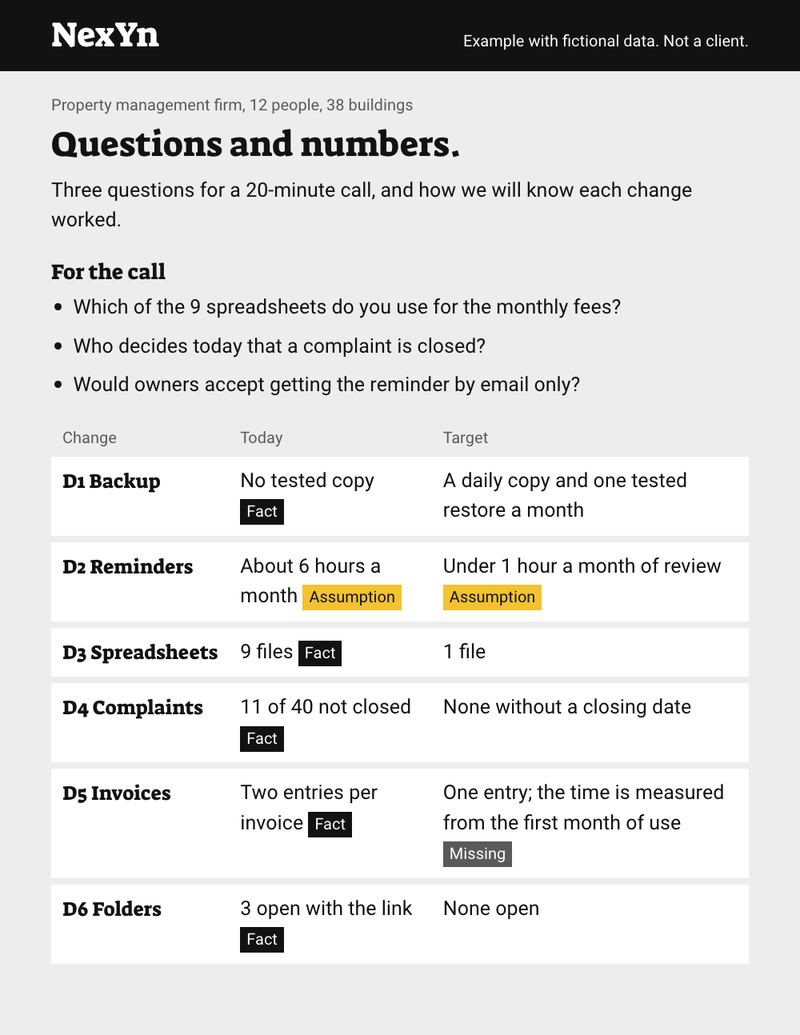
Questions and numbers.
Three questions for a 20-minute call, and how we will know each change worked.
For the call
- Which of the 9 spreadsheets do you use for the monthly fees?
- Who decides today that a complaint is closed?
- Would owners accept getting the reminder by email only?
| Change | Today | Target |
|---|---|---|
| D1 Backup | No tested copy Fact | A daily copy and one tested restore a month |
| D2 Reminders | About 6 hours a month Assumption | Under 1 hour a month of review Assumption |
| D3 Spreadsheets | 9 files Fact | 1 file |
| D4 Complaints | 11 of 40 not closed Fact | None without a closing date |
| D5 Invoices | Two entries per invoice Fact | One entry; the time is measured from the first month of use Missing |
| D6 Folders | 3 open with the link Fact | None open |